


Business Services Solution: Accounting / Tax / Audit Firm
The problem isn't technical expertise—it's operational control. Every accounting, tax, and audit firm knows how to do the work. The real question is whether client work gets delivered on time, at a consistent standard, and with an evidence trail that survives an audit of the auditor.

1) The most expensive part isn't the work—it's chasing documents and reworking
Professional services run on high trust and high compliance liability. A single missed filing, an inconsistent treatment, or a missing voucher can turn into penalties, rework, and damaged client trust. The pain points look the same across nearly every firm:
Document collection is repetitive and client cooperation is unstable. Invoices, bank statements, contracts, expense proofs, payroll, social security records, and cross-border evidence arrive from different channels. Clients submit late, miss items, or send the wrong format—forcing the same engagement to be reworked again and again.
Accounting treatment is inconsistent across the team. The same revenue, expense, fixed-asset, and tax event gets booked differently by different accountants, undermining comparability and audit pass rates.
Filing calendars are dense and easy to miss. Monthly, quarterly, and annual filings run in parallel, each client with different tax types and requirements. Manual tracking leaks deadlines and creates penalty risk.
Working papers and audit evidence are assembled by hand. Reconciliations, sampling, confirmations, and variance explanations require enormous document assembly; incomplete evidence leads to endless back-and-forth and delayed sign-off.
Communication is fragmented across channels. Calls, chat apps, and email scatter the key confirmations. When a dispute arises, nobody can prove who was told what, when, and on what basis.
Collections and renewals have no mechanism. Without standardized reminders, value reporting, and risk signals, clients pay late or leave at renewal.
2) The GT6-AI approach: turn professional delivery into a checklist-driven, evidence-retaining operating system
GT6-AI is not another "accounting software." It is an Organizational Intelligence platform that lets a small professional-services team operate like a much larger firm, with every step tracked, gated, and evidenced. The architecture has three layers:
Enterprise Back Office (the skeleton). Client profiles, service contracts and packages, document checklist templates, ledger and chart-of-accounts mappings, journal rule libraries, filing tasks and deadlines, audit work plans, review/approval flows, deliverables, and collection plans—all objectified in one system of record.
Messaging Collaboration Foundation (the nervous system). Reminders, client confirmations, exception explanations, and approval outcomes are captured as a searchable, time-stamped evidence trail that runs across email, chat, and WhatsApp.
Role-based AI Employees (the executors). AI Client Assistant, AI Document Steward, AI Bookkeeping Assistant, AI Filing Assistant, AI Working-Paper Assistant, AI Risk & Review Prompter, and AI Collections & Renewal Ops take over the repetitive, high-volume work—while qualified professionals keep final judgment and sign-off authority.
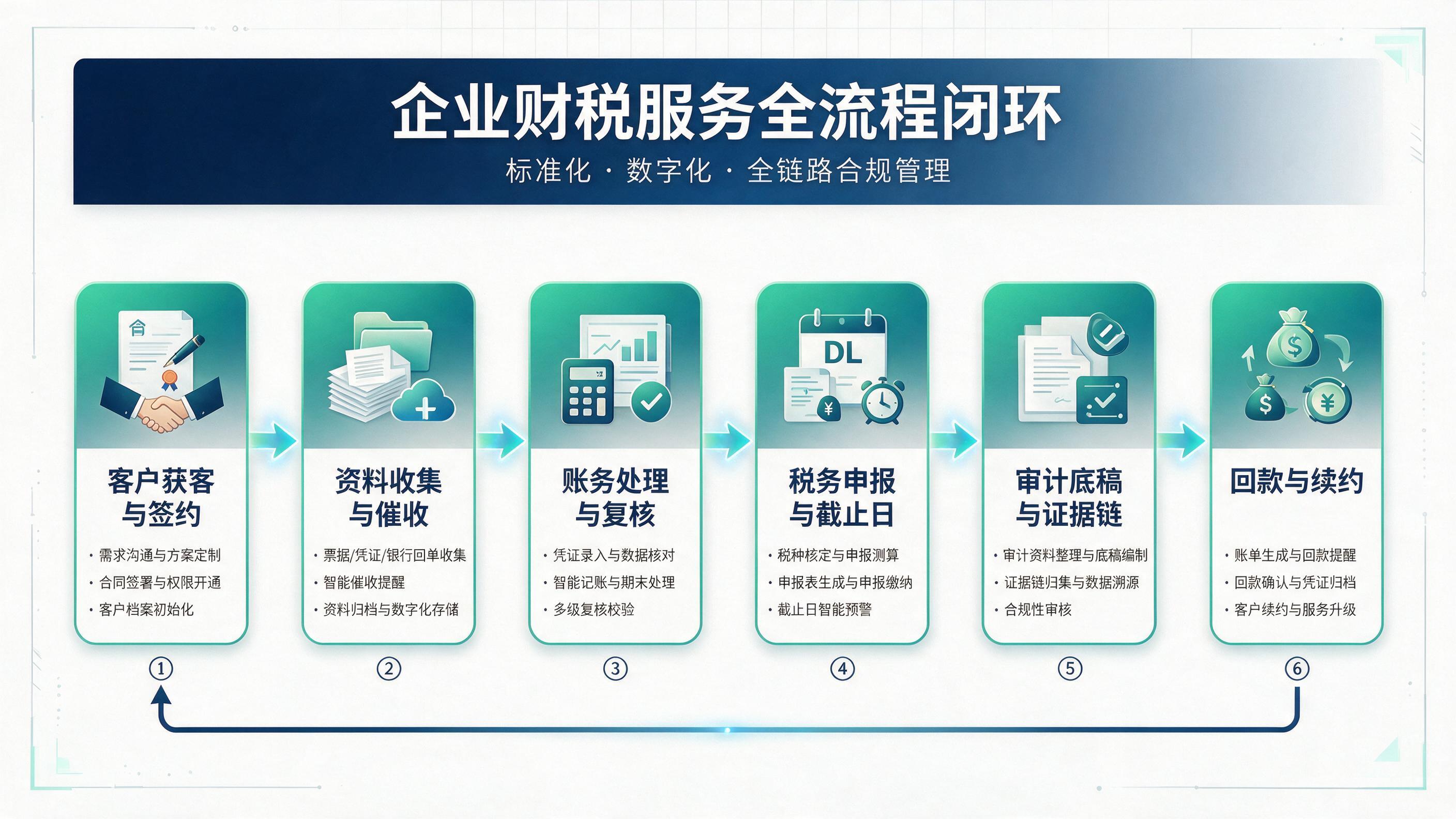
3) Where it lands: seven AI employees across the engagement lifecycle
Client acquisition & onboarding. AI Lead Collection Robot captures prospects from web forms, email, and WhatsApp; AI Consultation Assistant qualifies scope and quotes standard packages; onboarding checklists are generated per industry and service type so new clients start with a complete, agreed document baseline.
Document collection & validation. AI Document Steward runs periodic reminders per client and cycle, collects and classifies files, checks completeness (what's missing, wrong format, time mismatch), and generates "client confirmation sheets" that fix responsibility and treatment basis early.
Bookkeeping with consistent treatment. Journal rule libraries encode how common transactions should be booked, recognized, and tax-mapped. AI Bookkeeping Assistant proposes entries and flags anomalies—duplicate invoices, abnormal amounts, misclassified accounts, date mismatches—and prepares review lists. Core judgments are approved by senior staff before posting.
Tax filing with zero missed deadlines. Each client's tax types and cycles are objectified. The system generates monthly/quarterly/annual task lists with countdowns. AI Filing Assistant pushes document completion, produces filing drafts and variance notes, and escalates overdue risks automatically.
Audit working papers with evidence chaining. Working papers are produced from templates: reconciliations, sampling, confirmations, variance explanations, management representations. AI Working-Paper Assistant links vouchers, bank lines, contracts, invoices, and confirmation records to each audit point and drafts the first pass for reviewer sign-off—keeping the full audit trail for review and inspection.
Collections & renewal as a value conversation. Collection plans and reminder cadences follow contract terms. Before renewal, AI produces a per-client "value report"—filings completed, risks found, improvements suggested—so renewal becomes value-based rather than fee-based. High-risk clients are flagged for governance actions such as higher prepayment, tighter scope boundaries, or stronger approvals.
4) Implementation path: fix inputs first, then processing, then compliance closure
Phase A — Standardize document checklists and templates. Define required/optional/triggered documents per industry and service type. This fixes input quality before anything else.
Phase B — Standardize bookkeeping via rule libraries. Build journal rules and exception rules so the whole team books the same way; route core judgments through review and approval.
Phase C — Drive work from filing calendars. Objectify tax types and cycles; let deadlines, reminders, and escalation run the workflow.
Phase D — Automate working papers and evidence. Generate templates, chain evidence, and keep review sign-offs with full trails.
Phase E — Operate collections and renewals. Turn recurring service into stable cash flow with plans, value reports, and risk-driven governance.
5) Typical outcomes
- Higher document completeness and dramatically less rework
- Consistent treatment across the team; lighter reviews, steadier quality
- Fewer missed filings and lower penalty risk
- Faster working-paper assembly with auditable evidence trails
- Every client communication recorded and traceable
- Stable collections and renewals, so the firm scales with lighter staffing
Ready to run your firm on Organizational Intelligence?
Book a walkthrough and see how GT6-AI maps your client list, document checklists, filing calendars, and audit workflows onto one evidence-retaining operating system.