


Interior fit-out is a classic project-delivery business. One job can run weeks or months, with shifting requirements, on-site uncertainty, and tight coupling between material lead times and construction pace. Yet when we look at why fit-out companies get exhausted as they scale, the bottleneck is almost never craftsmanship — it is operational control.
1) Why fit-out companies get exhausted as they scale
Five problems cluster at the heart of most fit-out operations:
- Unstable leads and requirements. Leads come from many channels; customer data and conversation history are scattered. Requirement versions drift, causing repeated revisions and inconsistent commitments across sales, design, and delivery.
- Inconsistent quoting and uncontrolled variations. Quoting structures vary by estimator or project manager. Discounts and promises are made ad hoc. During delivery, "verbal variations" are common, leading to settlement disputes and distorted gross margin.
- Procurement not synchronized with site progress. Purchase planning relies on memory and manual follow-up. Materials arrive late (causing stoppages) or too early (causing damage, loss, and waste).
- Site facts don't become organizational evidence. Daily reports and photos live in chat groups. There is no structured evidence chain, so delays, defects, and rework are hard to attribute.
- High acceptance and after-sales cost. Acceptance criteria are inconsistent, increasing rework. After-sales response is slow and experience-driven, often escalating into disputes. Finance teams struggle to track collection milestones and real-time profitability.
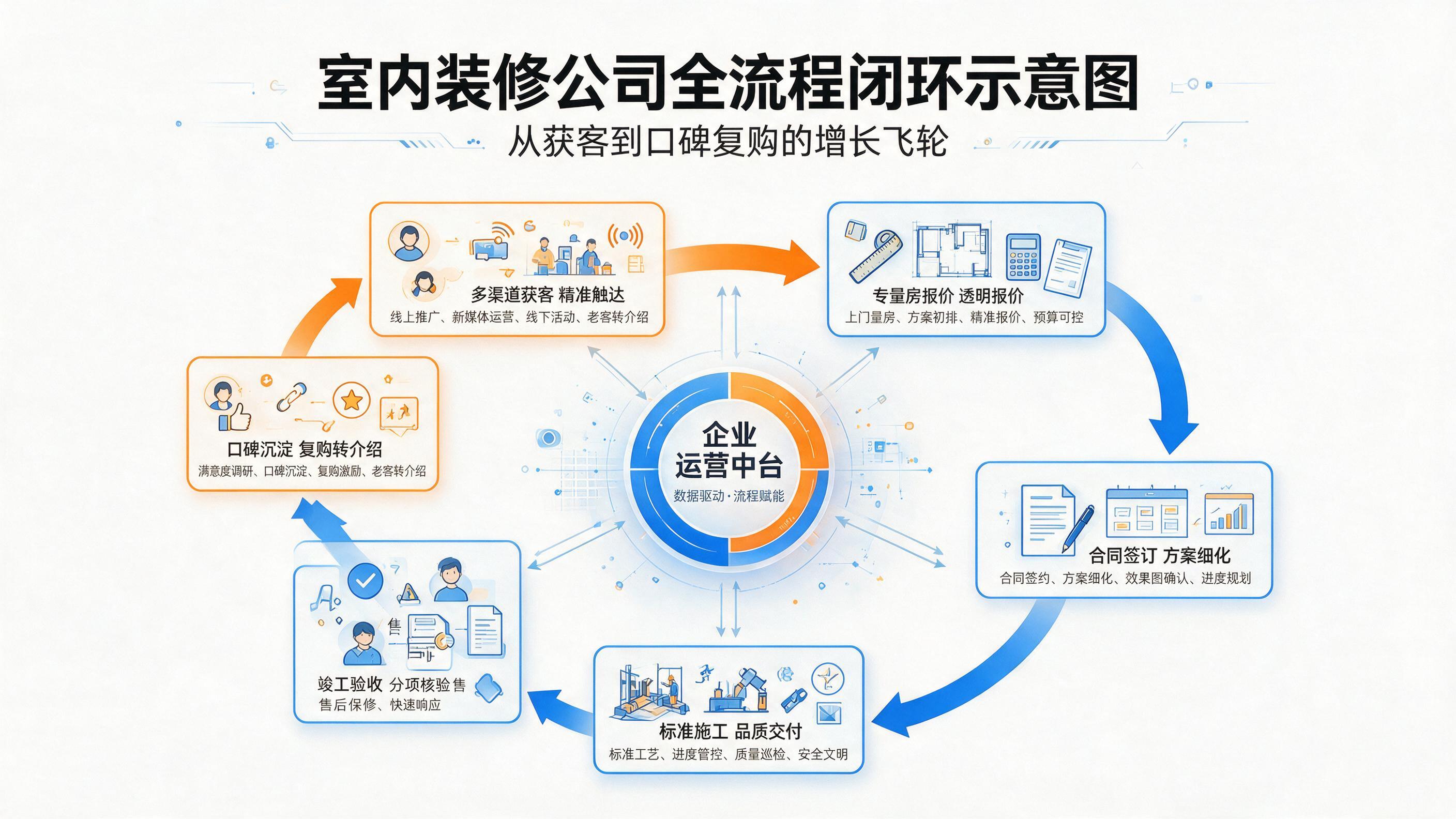
2) The GT6-AI approach: one back office, one fact stream, a team of AI employees
This solution is not about adding a chatbot. It upgrades the operating model into three aligned layers:
- Enterprise Operation Back Office — the skeleton. All core objects (customer / site / proposal / quote / contract / project / milestone / BOM / work order / acceptance / after-sales / finance) share one consistent structure and state model. Your business is "objectified" — expansion becomes configuration, not rebuilding.
- Messaging Collaboration Substrate — the nervous system. Every handoff, approval, exception, and handling record becomes searchable and traceable. The "fact stream" of the site no longer disappears into chat groups.
- Role-based AI Employees — the hands. Planning, estimating, project management, QA, procurement, after-sales, and finance each get defined responsibilities and standard outputs. High-risk actions are gated by approvals, so automation stays controlled.
3) Four stages, one closed loop
Stage 1 — Acquisition & Quoting: lock in leads and margin first
- AI lead-collection bots consolidate inquiries from website, social, and referral channels into one pipeline.
- AI consulting assistants answer quickly and qualify requirements on behalf of the business.
- AI estimating assistants generate standardized quote structures (materials / labor / management / overheads / taxes) with risk notes, and route final price, discounts, payment milestones, and key clauses through approval gates — preventing "sign-first, regret-later" commitments.
Stage 2 — Contract & Planning: make every promise structured
- Standardize the lifecycle model: customer → site → proposal → quote → contract → project → milestone → BOM → work order → acceptance → after-sales.
- Provide field and workflow templates for residential vs. commercial differences (area/space types, MEP/fire/HVAC scope, material brands/specs, regulatory needs).
- AI planning assistants produce style direction, material tiers, timeline plans, space/function lists, and milestone-based payment schedules — all linked to the contract.
Stage 3 — Delivery & Site Control: make progress, quality, materials, and change fully traceable
- AI project manager: milestone schedule, weekly plans, coordination, delay alerts, and automatic customer updates.
- AI site QA: checklist-based inspection per milestone, photo/video evidence requirements, and a rectification loop.
- AI procurement & site logistics: BOM-driven purchase plans, delivery reminders, shortage alerts, and milestone-linked arrivals.
- Change governance: every change must generate a structured change order (reason / scope / cost delta / schedule impact), require client confirmation + internal approval, and link to settlement and collection milestones — eliminating verbal scope creep.
Stage 4 — Acceptance, After-sales & Repeat: turn reputation into growth
- AI acceptance assistants standardize acceptance criteria and capture sign-off evidence, cutting rework and disputes.
- AI after-sales triages issues (leaks, cracks, doors/windows, electrical, sanitary, etc.), creates service tickets, schedules visits, confirms completion, and runs callbacks. High-risk complaints escalate with a full evidence bundle (contract, change orders, acceptance records, site photos, communication logs).
- AI reputation operations classify complaint root causes and route them into improvement tasks.
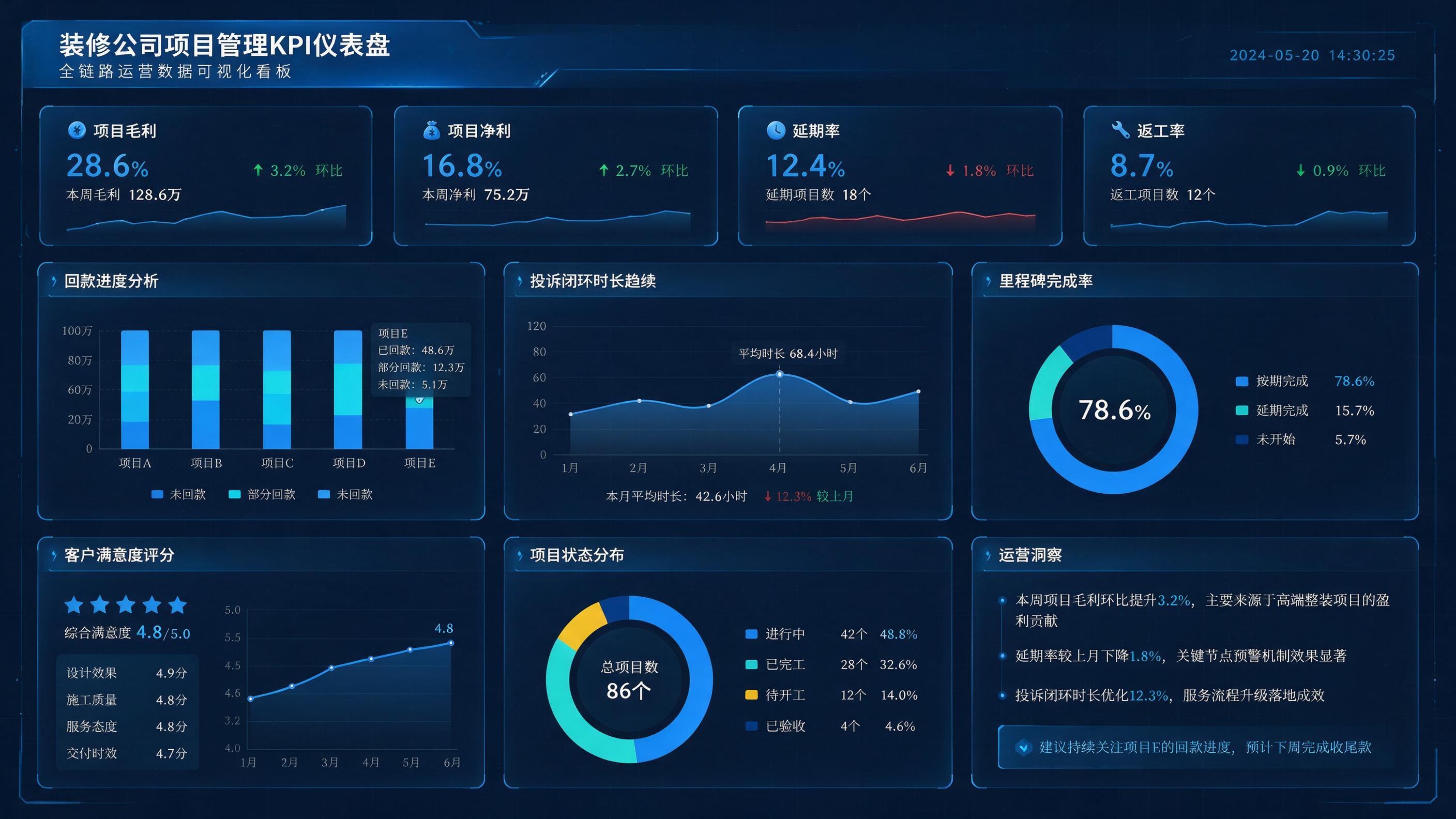
- AI finance analysis delivers milestone-based collection reminders and project-level P&L (materials + labor, variation income, rework losses), with dashboards for gross/net margin, delay rate, rework rate, complaint cycle time, and satisfaction.
4) Implementation path: back office first, roles next, full-loop integration last
- Phase A — Launch the project back office (objectify the business): standardize the lifecycle model and field/workflow templates for residential vs. commercial differences.
- Phase B — Establish the planning & estimation hub (protect margin first): deploy planning/design AI + estimating AI with approval gates on price, discounts, milestones, and key clauses.
- Phase C — Role-ize delivery: roll out project manager, site QA, procurement, and change governance SOPs.
- Phase D — After-sales & reputation ticketing: turn complaints into controlled workflows with escalation bundles.
- Phase E — Finance & operating dashboards: project profit at a glance, contract-to-profit review.
5) Typical outcomes: growth without "hiring your way out"
- More stable delivery — milestone and QA standardization reduces rework.
- Governed variations — approvals and linkage to settlement reduce disputes.
- Complete traceability — evidence chains clarify responsibility and reduce legal exposure.
- Faster collections — milestone-driven reminders stabilize cashflow.
- Clearer profitability — real-time project P&L supports faster decisions.
- Replicable operations — AI employees handle repetitive execution and reporting, so a small team can run more projects with consistent standards.
Ready to turn your fit-out operation into a controlled, auditable loop? Contact GT6-AI to apply for a phased implementation plan tailored to your project portfolio.