


The problem isn't trucks — it's operational control
A courier company runs on a high-throughput, high-constraint network: pickup riders, stations, hubs, linehaul and last-mile couriers move tens of thousands of parcels a day against tight time windows and razor-thin margins. The network is not destroyed by normal flow — it is destroyed by exceptions and information inconsistency:
- Tracking isn't trustworthy. Scans are delayed, skipped or inconsistent across nodes, so "where is my parcel" becomes a debate instead of a fact.
- Dispatch runs on tribal knowledge. Pickup and last-mile assignment, linehaul capacity and route balancing depend on a few experienced managers. When volume spikes or staff changes, performance degrades.
- Exceptions are slow and non-standard. Delays, damage, loss, refusals and address issues bounce between teams and partners without playbooks, evidence requirements or SLAs.
- Customer service is overloaded and inconsistent. Most inquiries are repetitive (tracking, delay, redirect), but without fact-bound replies, agents improvise and over-promise.
- Claims are high-friction. Damage and loss claims lack complete evidence chains, so disputes escalate and payout leakage grows.
- Settlement and partner governance are fragmented. Reconciliation with stations, franchisees and linehaul partners is slow when fee rules, SLA penalties and counts are scattered.
Courier operators don't need more software modules. They need an operating system that turns every node of the network into an executable, auditable, improvable loop — powered by GT6-AI Organizational Intelligence.
GT6-AI: the operating system for a courier company
GT6-AI is an organizational intelligence platform built on three layers:
- Enterprise Operations Back Office (the skeleton): unify shipments, routes, stations, hubs, vehicles and capacity, fee rules, partner contracts, SLA definitions, claims policies and settlement cycles — one source of truth for the whole network.
- Messaging Collaboration Foundation (the nervous system): every scan event, handoff, exception ticket, approval and resolution log is captured as a searchable fact stream, so nothing is lost in a phone call.
- Role-based AI Employees (the executors): AI Dispatch, AI Exception Coordinator, AI Customer Service, AI Claims Reviewer, AI Risk Analyst and AI Finance Reconciler work the company's SOPs around the clock, with escalation gates on high-risk actions.
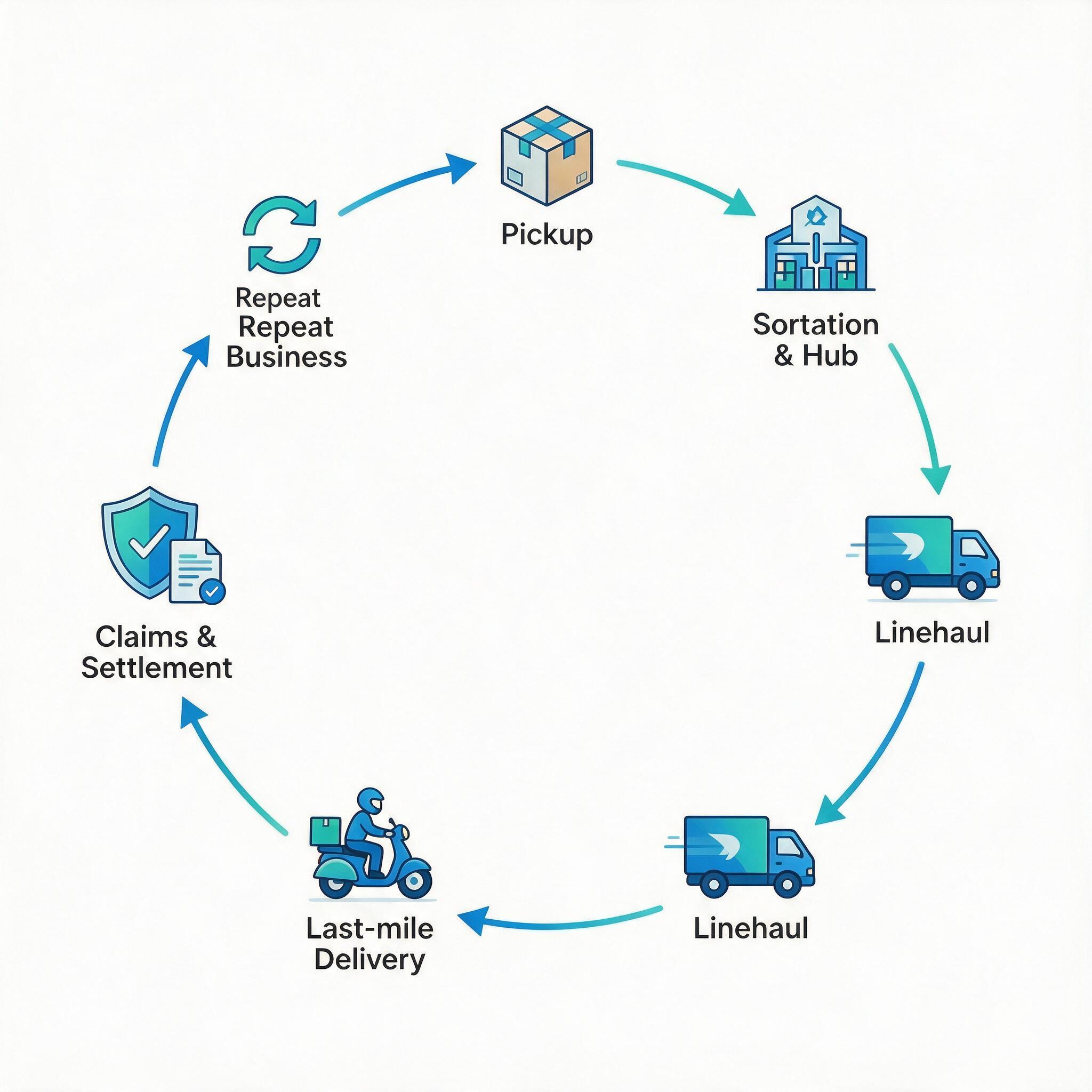
Closed loop: pickup → sortation → linehaul → last mile → claims → repeat
1) Pickup & order intake — every shipment becomes a controlled record
- AI enforces a strict shipment state machine (label → picked up → station inbound → hub inbound/sorted → linehaul departed/arrived → destination hub → out for delivery → delivered / exception / returned), with mandatory scan nodes and timestamps.
- AI Dispatch balances pickup assignments by distance, promised window and rider capacity, and routes new orders into the right station from the start.
- Scan discipline is enforced: every transition has clear rules for who can perform it and what evidence is required — eliminating ghost parcels.
2) Sortation & linehaul — capacity that doesn't collapse
- AI Volume Forecaster predicts daily flow from history, seasonality, promotions and weather, and outputs vehicle allocation and linehaul schedules.
- Hub congestion and route risk are detected early: AI triggers rerouting, overflow routing and temporary capacity before backlogs form.
- Peak surge playbooks standardize how the network absorbs spikes without hiring linearly.
3) Last-mile delivery — exceptions as tickets, not arguments
- Delivery is decomposed into accept → sort → route → attempt → POD (signature/photo/OTP), each step with evidence.
- AI Customer Service answers tracking, delay and redirect inquiries with fact-bound, policy-aligned replies based on trusted scan events — no over-promising.
- Any exception auto-generates a ticket: AI Exception Coordinator classifies it, requests missing evidence, proposes resolution actions and escalates when SLA timers breach.
- AI recommends route sequencing (drop density, time windows, failed-attempt risk) to raise first-attempt success.
4) Claims, settlement & retention — protect margin, grow volume
- Claims become auditable workflows: intake → evidence checklist → responsibility determination → payout decision → partner chargeback → closure. Claims AI pre-validates evidence and flags fraud signals (patterned claims, weight mismatches, repeated recipients).
- Finance AI prepares reconciliation packs, highlights anomalies and pre-builds partner dispute cases with evidence — faster settlement, stronger governance.
- Shipper and recipient retention: AI produces SLA performance reports, proactive delay notifications and service-quality reviews that convert operational discipline into repeat contracts and better CSAT.
Implementation path: standardize the flow first, then automate roles
- Phase A — Shipment state machine: build the single source of truth for status and scan evidence.
- Phase B — Exception taxonomy + SOP playbooks: standardize delay, damage, loss, refusal, address and handoff handling with evidence, actions, SLA timers and ownership.
- Phase C — Dispatch & capacity assistance: volume forecasting, route balancing and peak playbooks.
- Phase D — Customer service automation: fact-bound WISMO and controlled service actions.
- Phase E — Claims & compensation governance: evidence-driven decisions and fraud signals.
- Phase F — Finance reconciliation & partner performance: settlement packs and cost-per-parcel dashboards.
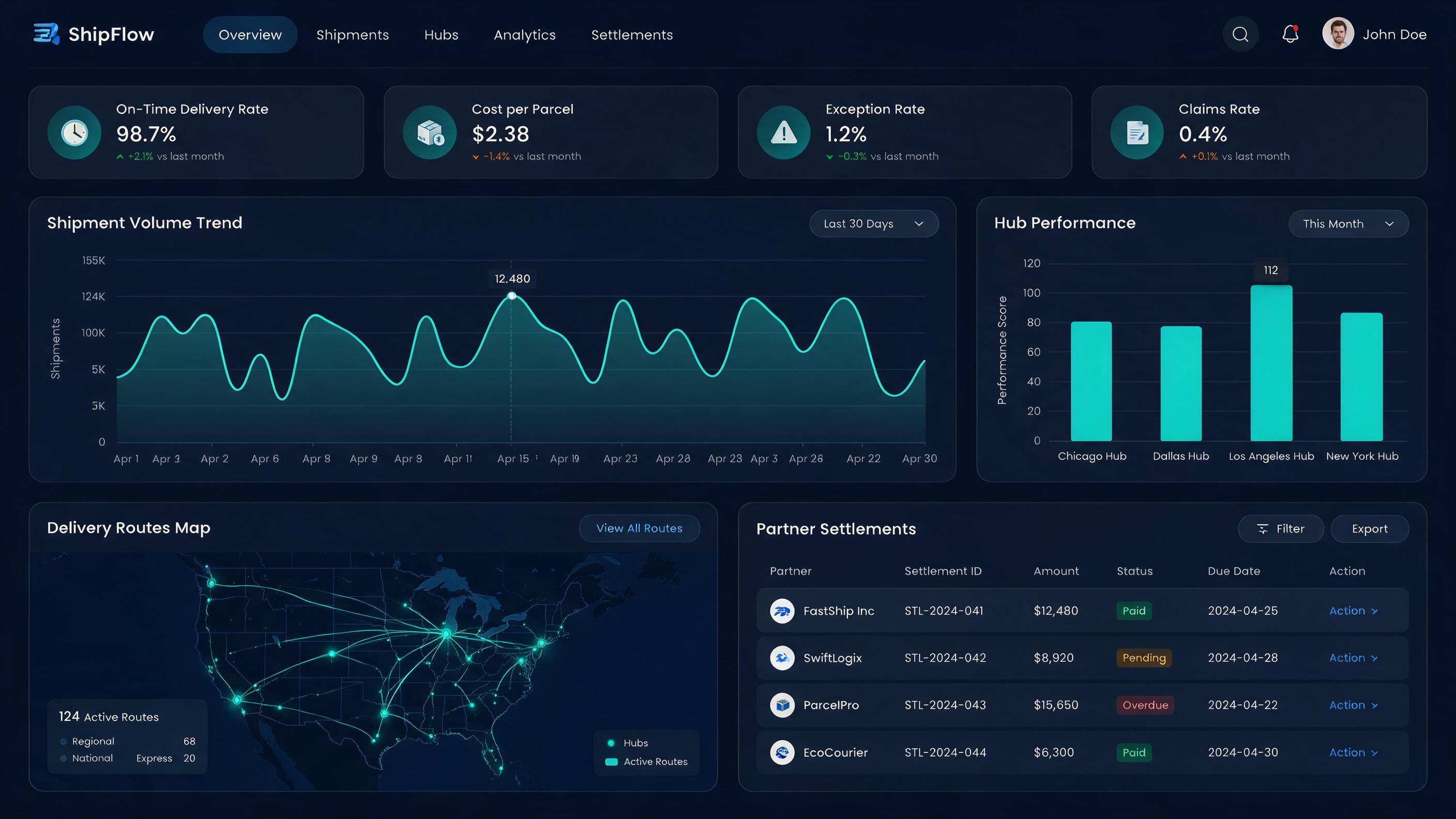
Typical outcomes
- Higher traceability: fewer tracking disputes, clearer accountability by node
- Faster exception closure: standardized workflows cut back-and-forth
- Lower CS workload: most inquiries handled automatically and consistently
- Reduced claims leakage: evidence-driven decisions plus fraud signals
- Improved on-time performance: early congestion detection and capacity actions
- Cleaner settlements: faster reconciliation and stronger partner governance
- Scalable operations: volume growth without linear headcount growth
Start with the loop that hurts most
You don't have to change everything at once. GT6-AI deploys in phases, starting from the link with the highest risk — usually the shipment state machine and exception handling, then dispatch and capacity, then customer service, claims and finance. Each phase is a working, measurable improvement.
Contact GT6-AI to map your courier network's current loop and get a phased implementation plan.