


DTC E-commerce Retail Solution: The Problem Isn't Selling. It's Operating.
For most DTC (Direct-to-Consumer) retail brands, the bottleneck is not building a storefront or launching ads. It's operations. Traffic spikes and disappears; conversion depends on whoever happens to write the copy; orders flow in but fulfillment breaks; customers buy once, and nobody knows why they don't come back. Fragmented tools, manual hand-offs, inconsistent brand messaging, and broken data feedback loops turn a "scalable" business model into a daily firefight.
The GT6-AI DTC E-commerce Retail Solution turns your brand into an auditable, trackable, and continuously improvable operating system — built on GT6-AI Organizational Intelligence: an Enterprise Operations Back Office (the skeleton), a Messaging & Collaboration Foundation (the nervous system), and Role-Based AI Employees and Workflows (the workforce). Even a lean team — or a "one-person company" — can run DTC with enterprise-level discipline.
The four breaks in most DTC operations
DTC looks simple: traffic, conversion, fulfillment, retention. In practice, each stage breaks in a predictable way.
- Traffic breaks when ad spend is not connected to reusable brand assets. Every campaign reinvents the message, audiences are guessed, and learnings disappear when the media buyer leaves.
- Conversion breaks when listing, content, and campaigns are produced by hand. Titles drift, visual style changes, pricing rules are applied inconsistently, and the storefront never speaks with one voice.
- Fulfillment breaks when orders, logistics, and support live in different tools. A customer asks "where is my order?" and three departments give three answers; returns and refunds become a cost center with no evidence trail.
- Retention breaks when no one owns the customer after the first purchase. Reviews are ignored, repeat purchase is luck, and profit is a spreadsheet that nobody updates.
The solution is not "more tools" or "more people." It is to make every stage a defined role with standard outputs, approvals, and evidence — and to let AI employees execute inside those roles.
GT6-AI: the three layers of Organizational Intelligence
GT6-AI runs your DTC company on three layers:
- Enterprise Operations Back Office — the skeleton. Organization, departments, roles, permissions, approvals, data definitions, and reporting all live in one console. Every role has defined inputs, standard outputs, executable SOPs, checklists, and approval gates.
- Messaging & Collaboration Foundation — the nervous system. Task streams, approvals, exceptions, alerts, and key decisions are captured as searchable records. Work actually moves here, and accountability is preserved.
- Role-Based AI Employees and Workflows — the workforce. AI is not a copywriting tool; it is a worker inside role boundaries. It executes tasks, delivers artifacts, and leaves an auditable trail.
With this architecture, DTC's four stages become a closed loop.
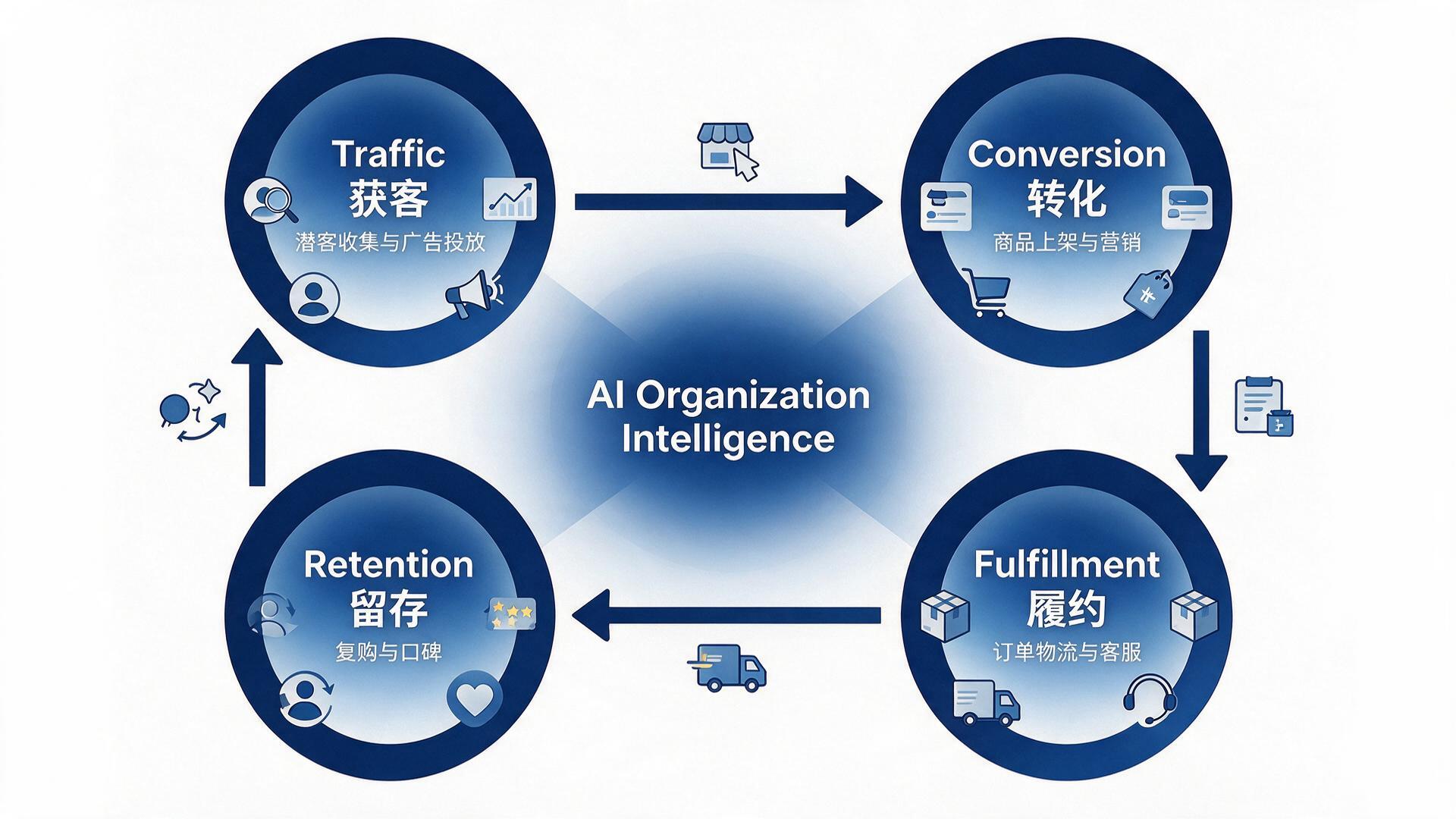
1) Traffic: convert ad spend into owned, reusable assets
Most DTC teams buy traffic as a service: every campaign is a new brief, a new audience guess, a new copy. GT6-AI changes this by making acquisition an asset-building process.
- AI Lead Collection Robot continuously gathers qualified leads across channels into the back office, deduplicates, scores, and routes them into the right nurture stream — so no prospect falls through the cracks.
- Marketing Email / WhatsApp Robots run lifecycle campaigns (welcome, abandoned cart, replenishment, reactivation) from structured templates with approval gates, keeping brand voice consistent while saving hours of manual send-out.
- Website Publishing Robot publishes landing pages, promotions, and product updates to the site from approved content — one source, one voice, full traceability.
- AI Growth Analyst proposes campaign structures based on inventory, margin, seasonality, and target ROI; when the campaign runs, learnings are written back into merchandising and pricing recommendations.
2) Conversion: standardize listing → content → campaign as roles
Conversion is where DTC usually "feels" creative — and where it drifts. GT6-AI turns it into defined roles with standard outputs:
- AI Merchandising Assistant filters product candidates by persona, style, and price band; drafts launch recommendations; flags risks. Humans only make final decisions.
- AI Listing / Publishing Robot generates titles, benefits, size/material details, FAQs, cross-sell bundles, and taxonomy tags — including multilingual variants — and produces an image requirement list (hero shots, detail shots, lifestyle scenes, size charts) based on templates.
- AI Content / Creative Robot produces short-form scripts, social captions, email themes, and landing page structures grounded in brand assets — keeping tone, visual direction, and value propositions aligned.
- AI Pricing & Promotion Assistant enforces pricing formulas, margin floors, and discount boundaries, so every promotion protects profitability.
The advantage is not "faster writing." It is standardized outputs: what fields must exist, what needs review, what can auto-publish, and how exceptions roll back. That is how conversion becomes replicable.
3) Fulfillment: orders, logistics, and support as one trackable loop
Fulfillment is the "second journey" of the customer experience. GT6-AI makes it one trackable loop:
- AI Customer Service Robot takes frontline conversations directly inside the messaging system — pre-sales sizing, checkout assistance, shipping tracking, return/exchange explanations, and complaint handling — with one voice and instant response.
- Order Status Machine keeps every order in a defined state (paid → packed → shipped → delivered → returned) with automatic alerts on exceptions; nothing waits for a human to remember it.
- Exception Work Orders are created automatically when delivery fails, a refund is disputed, or a review is negative; each work order carries the full evidence trail — chat history, order details, logistics, images.
- AI Finance & Reconciliation matches orders, payment channels, and ad spend attribution, so "how well we sell" and "how much we earn" are visible in the same system.
4) Retention: turn one-time buyers into repeat customers
For most DTC brands, retention is an afterthought. GT6-AI makes it a managed loop:
- AI Review / Reputation Robot monitors reviews across channels, classifies root causes, and converts complaints into corrective tasks for merchandising, fulfillment, or product teams.
- Member Segmentation & Lifecycle Robot groups customers by value, frequency, and category affinity, and runs personalized win-back, replenishment, and referral campaigns.
- AI After-Sales Robot enforces return policies, packages dispute templates, and flags high-risk refunds or suspected fraud before they become losses.
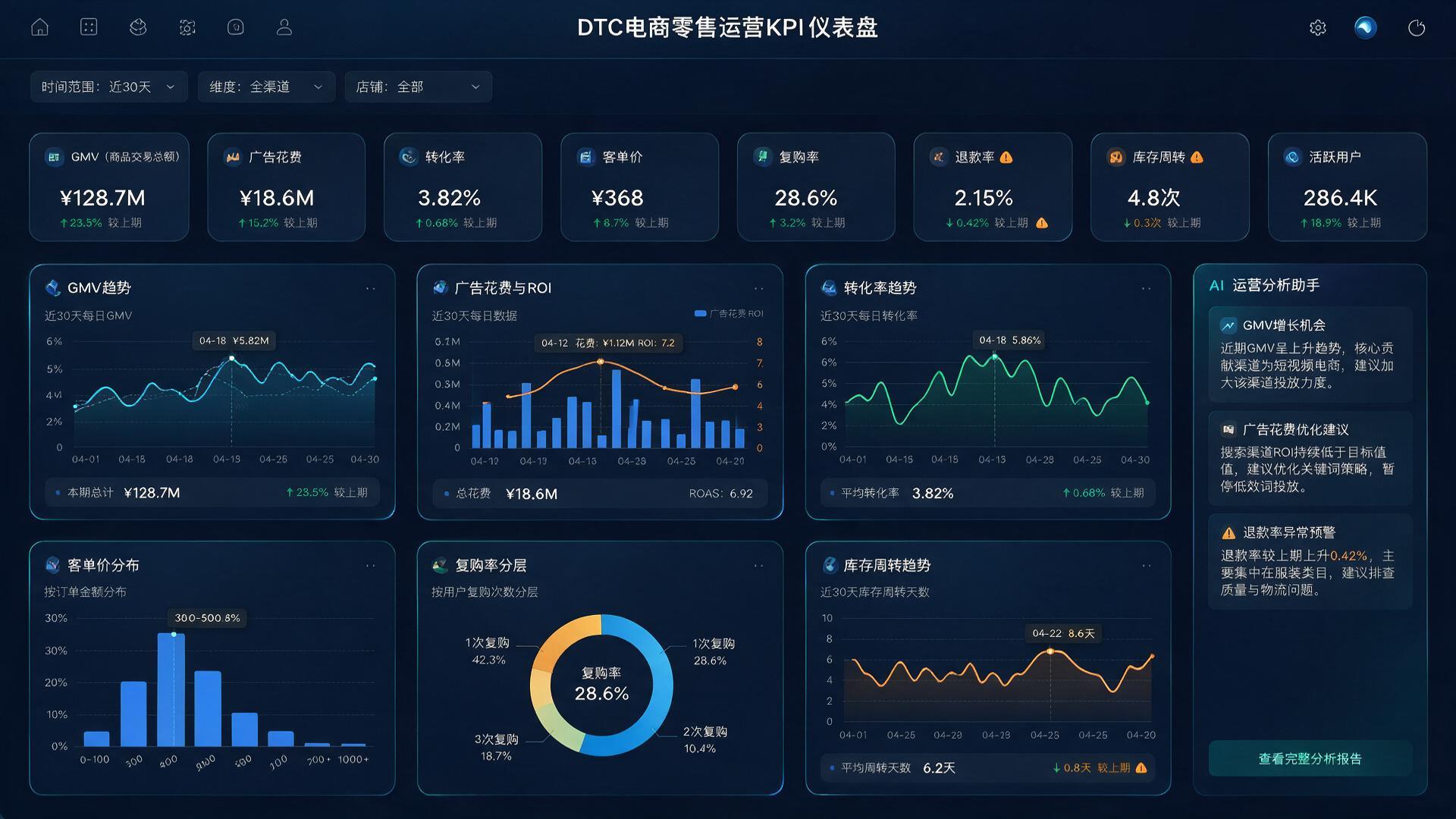
- AI Finance Analyst reports repeat-purchase rate, customer lifetime value (CLV), refund loss, and channel profitability — turning retention from a feeling into a number you can improve.
Implementation roadmap: from chaos to closed loop in stages
DTC brands do not need a big-bang transformation. GT6-AI rolls out in stages:
- Put the company online — one back office, one operating model, one source of truth for roles, approvals, and data.
- Generate the brand assets — brand introduction, personas, style guide, hero-product strategy, pricing standards, and differentiation messaging as structured assets.
- Standardize conversion — merchandising, listing, content, and campaign roles with AI employees.
- Close the fulfillment loop — order states, exception work orders, and AI customer service.
- Grow retention and profit — reviews, member lifecycle, finance analytics, and continuous improvement.
The outcome: DTC becomes a system, not a hero story
The real strengths of DTC — content-driven growth, rapid iteration, direct customer relationships — are converted into a data + workflow + AI workforce machine. Faster launches, consistent content, controllable acquisition, standardized support, transparent profitability, and manageable risk. For new brands, this means enterprise-grade operations at a fraction of staffing cost. For mature brands, it means turning experience into standards, standards into automation, and automation into long-term reusable operating assets.
Ready to turn your DTC brand into a system? Contact GT6-AI for a phased implementation plan tailored to your business.